The most reliable way to track BJJ belt promotions and stripes is to use dedicated gym-management software with a built-in promotion history, replacing error-prone spreadsheets with an auditable, always-accessible record.
Key takeaways
- Spreadsheets break under the weight of a growing club — they have no audit trail, no permissions model, and no mobile access on the mat.
- A good BJJ belt promotion tracking system records the date, belt, stripe count, coach, and any notes for every student in one place.
- Promotion criteria (attendance thresholds, competition results, coach sign-off) should live in the same tool as the records themselves.
- GDPR requires that student data — including progression records — is stored securely and only accessible to authorised staff.
- Automating promotion reminders and certificate generation can save a head instructor several hours per month.
Why Spreadsheets Fail for BJJ Belt Promotion Tracking
Almost every gym starts the same way: a shared Google Sheet with student names down the left, belt colours across the top, and a tangle of conditional formatting that made sense six months ago. For a class of twenty white belts it works fine. Then the gym grows, a second instructor joins, someone accidentally deletes a row, and suddenly nobody is sure when Maria earned her third stripe.
Spreadsheets have four structural problems for BJJ belt promotion tracking:
A promotion record should not live in someone's memory. It should be visible, auditable, and easy to carry from one academy to the next.
- No audit trail. When a cell changes, the history is gone unless you set up version control — which almost nobody does.
- No permissions. Every coach who can edit the sheet can also delete every record in it.
- No mobile-friendly view. Reading a wide spreadsheet on a phone between rounds of drilling is genuinely painful.
- No context. A cell that says "Blue 2" tells you nothing about when the stripe was awarded, by whom, or why.
None of these are criticisms of coaches — they are criticisms of the wrong tool for the job.
What a Proper BJJ Belt Promotion System Actually Needs
What data should you store per student?
At minimum, a useful promotion record contains:
- Current belt and stripe count — the obvious part.
- Full promotion history — every belt and stripe, with the date it was awarded.
- Awarding instructor — important for multi-location gyms and for accountability.
- Attendance at time of promotion — how many classes had the student attended before this milestone?
- Notes — competition results, injuries that delayed progress, coach observations.
- Certificate or signed record — especially relevant for higher belts where a verifiable lineage matters. Storing all of this in a single student profile, rather than scattered across a sheet and a WhatsApp group and a paper binder, is what separates a system from a workaround.
How should promotion criteria be defined?
The best gyms do not promote on feel alone — they define minimum criteria and then use judgement on top of them. A typical framework looks like this:
The useful record is not just current belt and stripes. It is who awarded them, when, and why.
- Attendance threshold: e.g. at least 100 classes before a blue belt can be considered.
- Time-in-grade: e.g. a minimum of 18 months at blue before purple is on the table.
- Technical sign-off: a checklist of positions and submissions the student must demonstrate competence in.
- Competition or in-house testing (optional): some gyms require it, others do not — both are valid.
When these criteria live inside the same tool as the student records, instructors can see at a glance who is approaching eligibility. That is far more useful than manually cross-referencing a spreadsheet against an attendance register.
How to Migrate Away from a Spreadsheet
Step 1: Audit what you actually have
Before importing anything, spend an hour cleaning your existing data. Common problems:
- Inconsistent belt names ("Blue Belt", "blue", "BB" all meaning the same thing).
- Missing start dates — you know someone is a blue belt, but not since when.
- Duplicate entries from students who rejoined. It is worth the effort. Bad data imported into a good system is still bad data.
Using Compteam? The AI-assisted athlete import reads unstructured data — paste a list of names, emails, and dates in any format and the AI maps each value to the right field automatically. No column headers, no reformatting required, which means you can skip most of this cleanup step.
Step 2: Choose a tool built for martial arts
Generic project-management tools and CRMs can be made to work, but they lack the BJJ-specific data model. Look for software that has:
The migration is not the hard part. The hard part is admitting the spreadsheet has become part of the problem.
- A dedicated belt/stripe field (not just a tag or a custom text box).
- Promotion history as a first-class feature, not an afterthought.
- Role-based access so head instructors, coaches, and reception staff see only what they need.
- Integration with your attendance and membership data — promotion decisions are far better when you can see class counts alongside belt records.
- GDPR-compliant data storage, ideally with EU-based servers if you are operating in Europe.
CompTeam is built specifically for this: belt promotions and stripe tracking are core features, tied directly to membership and attendance data, with GDPR tooling included.
Step 3: Set up your promotion workflow before you import students
Define your criteria in the system first. Then import students. Otherwise you will import everyone and immediately have a backlog of "who is ready?" questions with no structured way to answer them.
Step 4: Run both systems in parallel for one month
This feels inefficient but it is good insurance. Update both your spreadsheet and your new system for four weeks. At the end of the month, compare them. Any discrepancies reveal data-entry habits you need to fix — much better to find them now than six months later when a student disputes their stripe count.
Practical Tips for Day-to-Day BJJ Belt Promotion Tracking
How do you handle stripes between formal gradings?
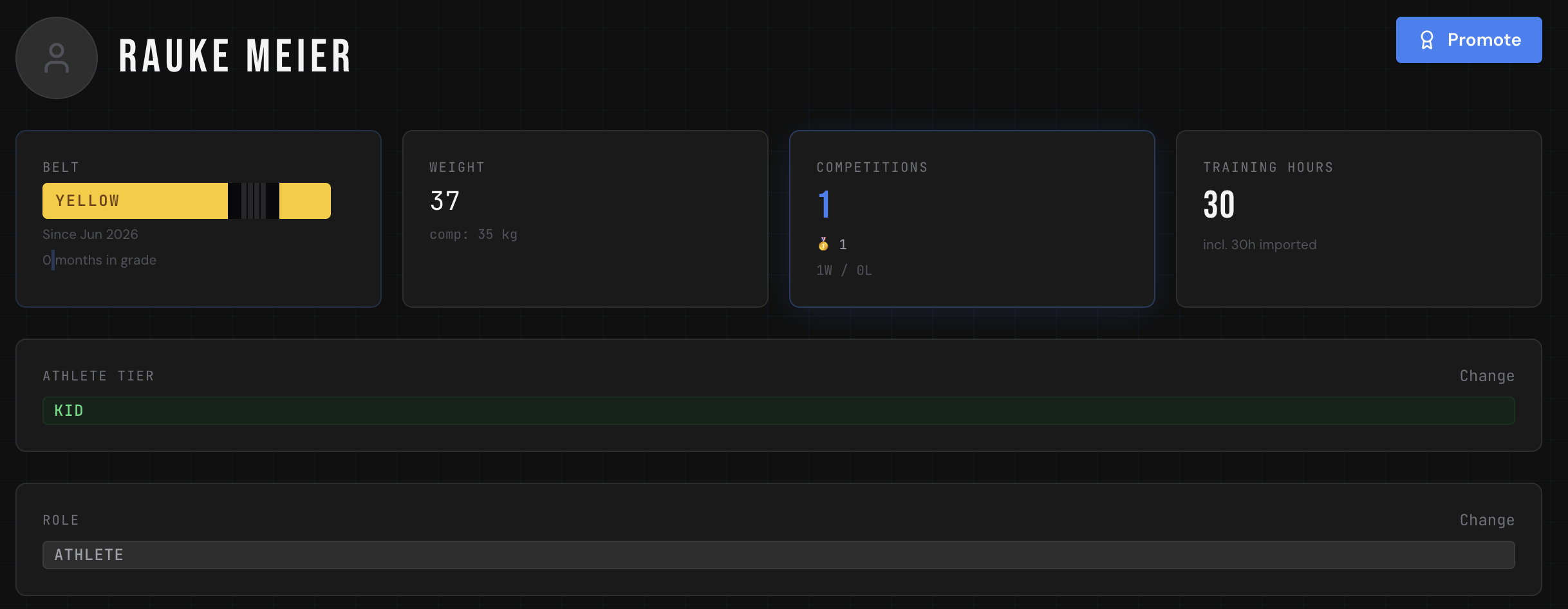
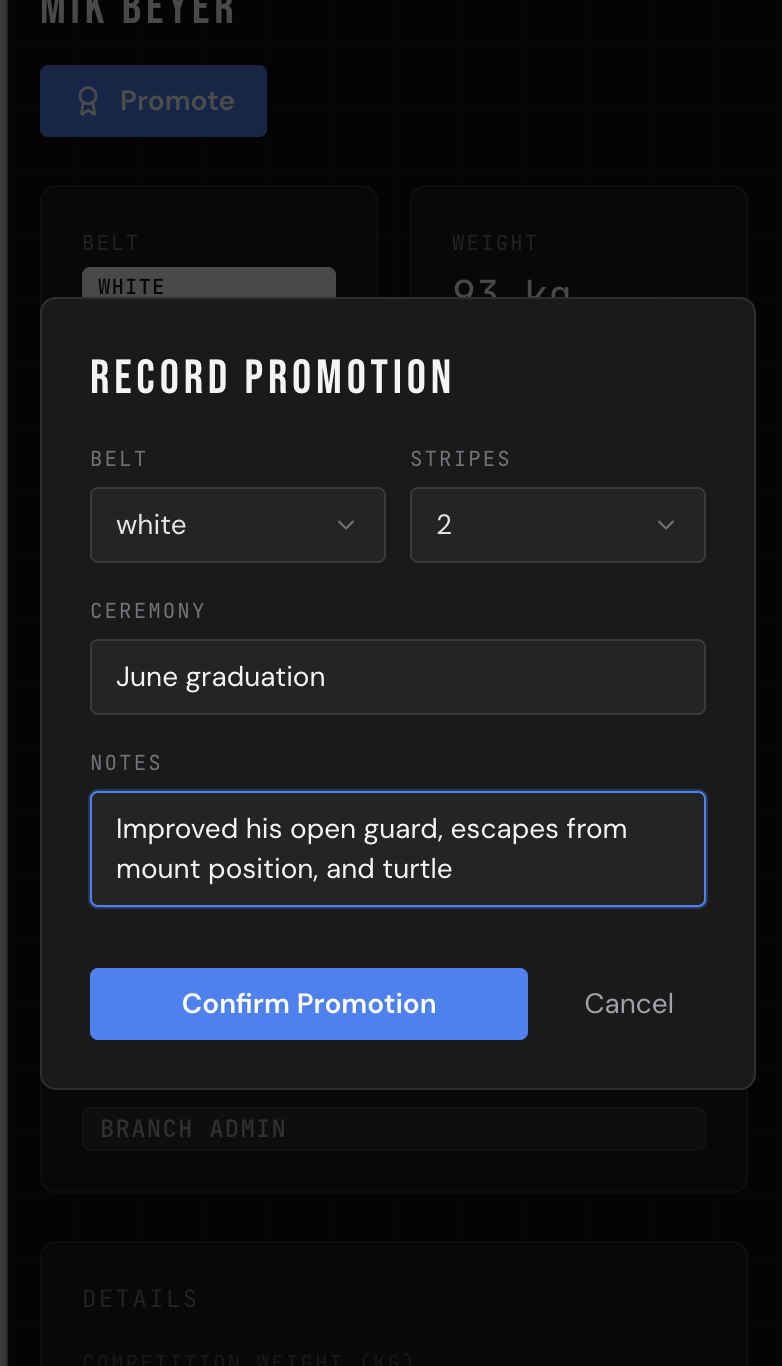
Stripes are informal in many academies — handed out at the end of a regular class, not at a ceremony. Your tracking system needs to make this frictionless. A coach should be able to open a student profile on their phone, tap "add stripe", and be done in ten seconds. If the process takes longer than that, coaches will stop doing it consistently.
Batch entry is also useful: after a class where several students received stripes, a coach should be able to select multiple students and award the same stripe level at once.
What about students who train at multiple locations?
For gym groups with more than one branch, centralised tracking is essential. If a student trains three days a week in Berlin and one day in Hamburg, both coaches need to see the same record. Local spreadsheets per branch are a recipe for conflicting records and awkward conversations.
How do you manage promotion records for lapsed members?
Students leave and come back. Sometimes after two years, sometimes after five. A searchable promotion history means you can pull up their record in seconds rather than digging through archived spreadsheets. This also protects the gym: if a returning student claims they were a blue belt second stripe, you have the record to confirm or correct that.

Should students be able to see their own promotion history?
Yes, and more gyms are doing this through member-facing portals. Transparency builds trust. Students who can see their attendance count and where they stand relative to promotion criteria are more motivated and less likely to feel a promotion was arbitrary. It also reduces the number of "when am I getting my next stripe?" questions at the end of class.
GDPR Considerations for European Gyms
If you operate in the EU or UK, student progression records are personal data under GDPR. This means:
- You need a lawful basis for processing them (legitimate interest or contract performance typically covers this).
- Records must be stored securely, with access limited to authorised staff.
- Students can request a copy of their data, including their promotion history.
- If a student requests erasure, you need to be able to action that — something a shared Google Sheet makes practically impossible to verify.
Using software with built-in GDPR tooling — data export, access logs, retention policies — is not just convenient, it is the responsible choice for a professional gym.
What to Look for in BJJ Belt Promotion Tracking Software
To summarise the key evaluation criteria when choosing a tool:
| Criteria | Why it matters |
|---|---|
| Belt + stripe as native fields | Ensures data consistency across the team |
| Full promotion history per student | Audit trail and lineage verification |
| Linked to attendance data | Better promotion decisions |
| Role-based access | Protects data, respects hierarchy |
| Mobile-friendly | Coaches actually use it on the mat |
| EU data residency | GDPR compliance without extra work |
| Member-facing portal | Reduces admin questions, motivates students |
No tool will be perfect, but this checklist separates purpose-built solutions from generic tools that have been stretched to fit.
Making the Switch: It Is Simpler Than It Sounds
The biggest barrier to moving away from spreadsheets is not technical — it is psychological. The spreadsheet feels known, controllable, free. But the hidden costs are real: hours spent reconciling data, coaches making promotion decisions without full information, GDPR exposure, and the creeping anxiety of knowing the system is fragile.
Most gyms that make the switch report that the migration takes less than a day and that within a month they cannot imagine going back. The data is cleaner, promotions are more consistent, and coaches spend their energy on coaching rather than administration.
BJJ belt promotion tracking done well is not bureaucracy — it is respect for the tradition of the art and for the students who are working hard to earn each stripe.
Frequently asked questions
What is the best way to track BJJ belt promotions for a small gym?
Even for small gyms, dedicated martial arts management software is more reliable than a spreadsheet because it maintains a full promotion history, restricts access by role, and works on mobile. Free tools exist, but purpose-built platforms give you attendance integration and GDPR compliance from the start.
How do I record BJJ stripes when they are awarded informally after class?
Use software with a mobile-friendly student profile so a coach can add a stripe in seconds from their phone. Batch entry — selecting multiple students at once — also helps when several stripes are awarded in the same session.
Is a student's BJJ belt promotion history personal data under GDPR?
Yes. Promotion and progression records are personal data under GDPR because they relate to an identifiable individual. EU gym owners should store this data in a system with access controls, audit logs, and the ability to export or delete records on request.
Can students see their own belt and stripe history?
Many modern BJJ gym management platforms offer a member-facing portal where students can view their current belt, stripe count, attendance, and promotion history. This transparency tends to increase motivation and reduce the number of informal questions coaches receive about upcoming promotions.
How do I track BJJ promotions across multiple gym locations?
Use a centralised platform where all branches share the same student database. This ensures that a student training across multiple locations has one consistent record visible to all authorised coaches, preventing conflicting promotion histories.
What should a BJJ promotion record include beyond belt and stripe?
A thorough promotion record should include the date awarded, the awarding instructor, the student's class attendance count at the time, any relevant notes such as competition results, and ideally a digital certificate or signed confirmation for higher belts where lineage verification matters.