Why New BJJ White Belts Quit — and What Good Coaches Do Differently
First, let’s bust a myth: most new white belts do not leave your club because Brazilian Jiu-Jitsu is too difficult.
They leave because, during their first few weeks, they feel lost, anonymous, or unsure whether they are making progress. They start doubting whether they have the mental and physical ability required for such a demanding sport.
Good coaches cannot make the sport easy—but they can make the beginning feel worth continuing.

The First 90 Days Feel Different to a Beginner
An experienced practitioner knows that confusion is part of learning.
A new student does not. They walk into a room where everyone seems to know the rules, the technique, and one another. Then they spend an hour being told what to grab, not to spaz, not to turn the wrong way, or not to leave an arm exposed—often while partnered with a higher belt or a more experienced white belt who would rather roll with a friend.
At this stage, beginners are not yet attached to the academy, the group, or even to BJJ. Missing one class is easy. Missing a week is easier. Soon, returning feels awkward, and the quiet cancellation arrives.
The experience of trying BJJ can be exciting. It can also feel like repeated failure.
In many gyms today, demand for BJJ trial classes is high, and white belts or complete beginners can make up 70–80% of the room. Handling newcomers is therefore not a soft extra. It is a decisive coaching skill for retaining attendance, membership, and revenue.
So what can gym owners and coaches do differently to smooth the start and grow a healthier academy?
1. Make the First Class Predictable
A first class should not begin with a mystery. Tell the student where to put their shoes, how people line up, what tapping means, and what will happen during sparring. If they can sit out a round or work only with a coach, say so before they need to ask.
This takes two minutes—or no time at all when the right information is shared before arrival—but it removes a great deal of anxiety. The goal is not an elaborate orientation. It is to stop the student spending the entire class wondering whether they are doing something wrong.
Retention starts by recognising that the beginner is deciding whether they belong long before they understand the sport.
End by giving them one clear next step: which class to attend next and what they should bring.
On CompTeam: CompTeam helps academies share important information with leads upfront instead of leaving them in the dark. Branch admins can customise a White Belt Cheat Sheet with their academy's own etiquette, hygiene, safety, and first-class rules. From the Leads page, they can preview it as a PDF and attach the saved version directly to a prospect's welcome email—so expectations are clear before the student arrives.
2. Give Them a Training Partner, Not Just a Technique
Beginners often remember how a partner treated them more clearly than the technique being taught. Pair a new student with someone controlled, patient, and able to let them work. The most athletic upper belt is not automatically the best choice.
A reliable partner can explain the rhythm of drilling, keep the round safe, and introduce the newcomer to other members. That creates a small social bridge into the academy.
Once someone expects to see them again, returning becomes easier.
Avoid leaving partner selection entirely to the room during the first weeks. Experienced teammates naturally choose familiar partners, which can leave the newest person feeling like the last one picked.
3. Teach Survival Before Victory
New white belts often judge themselves by whether they win a round or submit someone. That is a miserable scoreboard for a beginner.
Good coaches give them earlier definitions of success: breathe while under pressure, keep the elbows safe, recognise a bad position, escape the mount, or complete one technical stand-up correctly. These are achievable wins, and each one proves that training is producing something.
Tell the student when you see one of those wins. A short, specific comment—“You stayed calm and recovered your guard”—is more useful than a general “good job.”
It shows them what progress looks like before they can recognise it themselves.
On CompTeam: This can become more structured without becoming mechanical. Coaches can evaluate skills from their phone or desktop and share the result with the student. Instead of guessing what went wrong, the beginner sees specific feedback, feels recognised, and has a concrete reason to continue.
4. Notice Absence Without Creating Pressure
Attendance should help a coach notice people, not police them. If a previously regular beginner disappears for a week or two, a simple personal message can reopen the door:
“We missed you at training. No pressure—I just wanted to check that everything is okay. You are welcome back whenever you are ready.”
The tone matters. Do not lead with payments, missed classes, or guilt. Injury, work, family routines, and simple soreness are common. The purpose is to show that the person was noticed.
This is where a consistent attendance record helps. A coach cannot remember every pattern in a growing academy, but the record can surface a change while there is still time to respond like a human.
On CompTeam: New students can register instantly, mark the classes they intend to attend, and check in at an academy kiosk; a coach can also check them in directly. In the athlete details page, the coach can review the student's training hours and attendance information. Branch admins can open Details inside the Training Hours box to see the complete attendance record for the last four weeks. This gives the team useful context before reaching out, without turning attendance into pressure.
5. Make Progress Visible Before the First Stripe
In any serious martial arts club, stripes and belts are not awarded as a retention trick. If a club uses promotion mainly to keep people paying, it risks credibility problems inside the wider community.
The consequence of strict, skill-based promotion is that a beginner’s first formal recognition may be months away. In BJJ, it can easily take more than six months before a first stripe is awarded.
If stripes are the only visible milestones, a beginner can train for a long time without evidence that they are improving.
So create smaller markers: better guard retention, calmer breathing under pressure, finishing a controlled round without panic, attending consistently, or understanding one recurring position. These do not need certificates or ceremonies, which can feel empty once the student realises skill was not the deciding factor. They need acknowledgement.
Students need acknowledgement for their improvements in mastering the art.
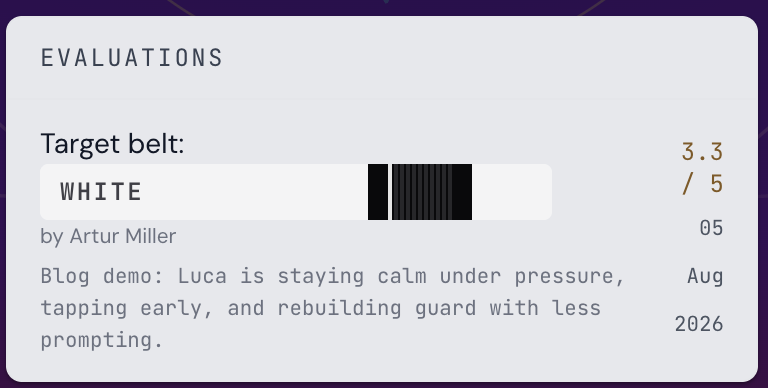
On CompTeam: Progress becomes visible in one athlete record. Students can track their own attendance and build their training-hour total, so athletes can witness their own consistency first hand, and coaches have a clear picture without reconstructing it from memory. Coaches can also complete structured skill evaluations against the criteria for a target belt or stripe; every evaluation preserves the scores, notes, date, average, and the coach who made it. That context sits alongside the athlete's belt history and competition record, giving the coaching team a shared picture even when different instructors teach on different days.
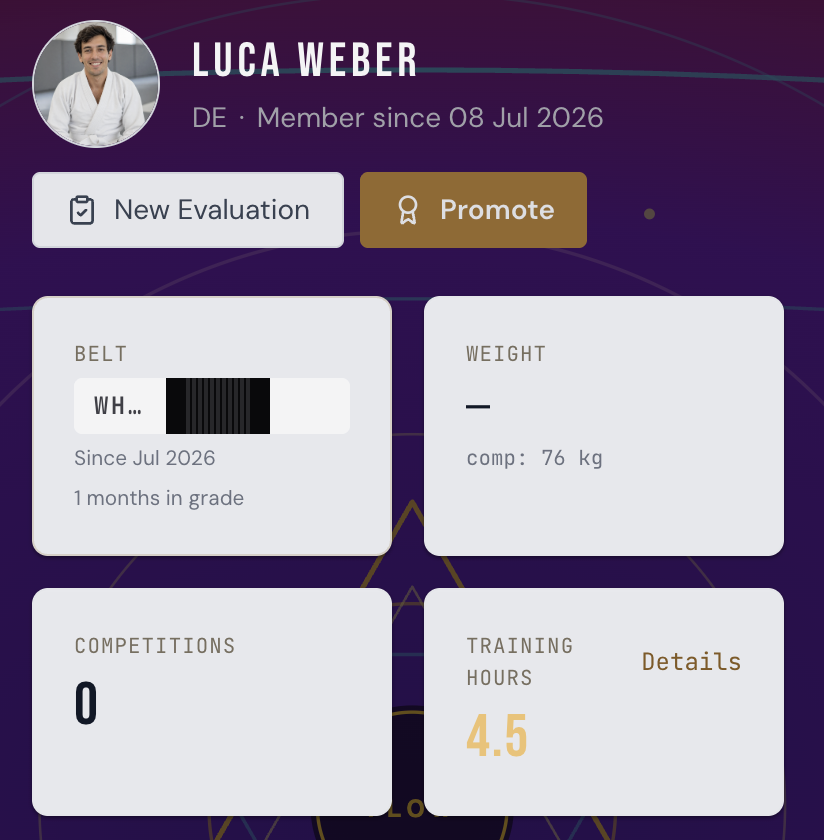
The practical value is the conversation it enables. A coach can show a beginner that they have trained regularly, improved in specific areas, and moved closer to an agreed milestone—even if a stripe is not due yet. The athlete can see their own training hours and progression history, while promotion decisions remain with the coaches. CompTeam preserves the evidence; it does not turn an attendance number or evaluation score into an automatic promotion.
On CompTeam: The weekly club briefing flags usually active students who have not checked in to a class for 20 days or more. This means coaches do not have to keep every absence pattern in their head, but can still notice a disappearing beginner and send a personal, pressure-free message before the absence becomes a cancellation.
6. Speak to the Quiet Students
Confident students ask questions and quickly become visible.
Quiet beginners are often the majority. They may arrive, train, and leave without ever demanding attention. They are easy to mistake for people who simply prefer to be left alone.
Ask one real question after class: “How did that round feel?” or “Was anything confusing today?” Listen without immediately correcting everything. Sometimes the issue is technical. Sometimes they are intimidated, struggling with the schedule, or convinced they are the only person who cannot keep up.
A thirty-second conversation can correct a story the beginner has been telling themselves for a week.
Retention Is a Coaching Skill
Not every departure is preventable. People relocate, change jobs, get injured, or discover that grappling is not for them.
A good retention process is not about making cancellation difficult or chasing every student indefinitely. It is about understanding the gaps that lead to member attrition and making small adjustments that eventually become a distinct club culture.
It is also about giving each beginner a fair chance to experience what keeps long-term practitioners on the mat: useful progress, trusted training partners, and a sense that their presence matters.
The best academies do not simply teach new white belts how to survive bad positions. They help them survive the uncertain period before BJJ begins to feel like home.
See how CompTeam helps academies understand member retention →
Frequently Asked Questions
When are new BJJ students most likely to quit?
The first few weeks and months are especially vulnerable because beginners have not yet built a routine, friendships, or a clear sense of progress. A predictable introduction and early personal connection reduce that uncertainty.
Should coaches contact a white belt who stops attending?
Yes, once, with a friendly and pressure-free message. The purpose is to show that the student was noticed and remains welcome—not to demand an explanation or start a sales conversation.
Does attendance tracking improve BJJ member retention?
Attendance tracking cannot create belonging by itself, but it can reveal when a regular beginner's pattern changes. CompTeam turns confirmed check-ins into attendance history and training hours, then its weekly club briefing flags active students who have not attended for 20 days or more. That gives the coach an opportunity to check in before a short absence becomes a permanent departure.
How can a coach show progress before a student's first stripe?
Recognise small, specific improvements such as calmer breathing, positional awareness, safe tapping, a first escape, curriculum completion, or consistent attendance. Beginners stay motivated when they can see what is changing.
Which CompTeam features help academies retain white belts?
CompTeam supports the full beginner journey:
- Before the first class: public trial booking and lead capture, one-to-one lead email, class schedules and registration links, plus the customisable White Belt Cheat Sheet PDF attached to the welcome email.
- Building a routine: athlete and guardian class booking, waitlists with automatic promotion, mobile and kiosk check-in, attendance history, and accumulated training hours.
- Making progress visible: the athlete profile, coach-attributed skill evaluations and notes, belt and stripe history, competition records, and verifiable promotion certificates. See the progression tools →
- Catching disengagement early: the weekly club briefing flags students absent for 20+ days, while lead conversations let staff follow up personally.
- Removing avoidable reasons to leave: self-service membership plans and billing, membership pause requests, cancellation notice handling, and guardian-controlled attendance, consent, and billing for younger white belts.
- Learning from departures: the attrition report shows cancellation trends, reasons, comments, plan context, and comparison with the previous quarter so the academy can improve its onboarding, schedule, pricing, or coaching process.
These tools make patterns and next actions visible. Retention still depends on a coach creating a safe room, recognising progress, and building real relationships.